Women Candidates in Election 2018: One Year from Election Day

Has there been a “surge” of women running for office after election 2016? With one year until the 2018 elections, we took a look at the numbers of women candidates to assess the degree to which media narratives about, and anecdotal evidence of, women’s heightened political engagement have translated into bids for office. In comparing the numbers of women running this cycle with the number at this point in previous cycles, we find that there are more women running for office in 2018, but that the increases in candidacies vary by level of office. 

Report
Analysis
A Closer Look
Candidates
Officeholders
Statewide Executive
U.S. Congress

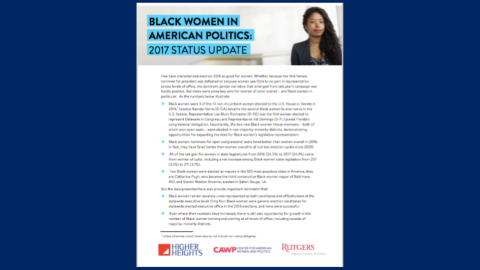
Black Women in American Politics: 2017 Status Update

This update highlights the key wins for women of color overall – and Black women in particular - in election 2016. The data demonstrate that, even with the gains Black women saw at some levels of office in 2016, there is more work to do to ensure that Black women’s representation in elected office reflects their presence in American society. 

Report
Analysis
Status of Black Women in U.S. Politics
Officeholders
Candidates
U.S. Congress
Statewide Executive
State Legislature
Local

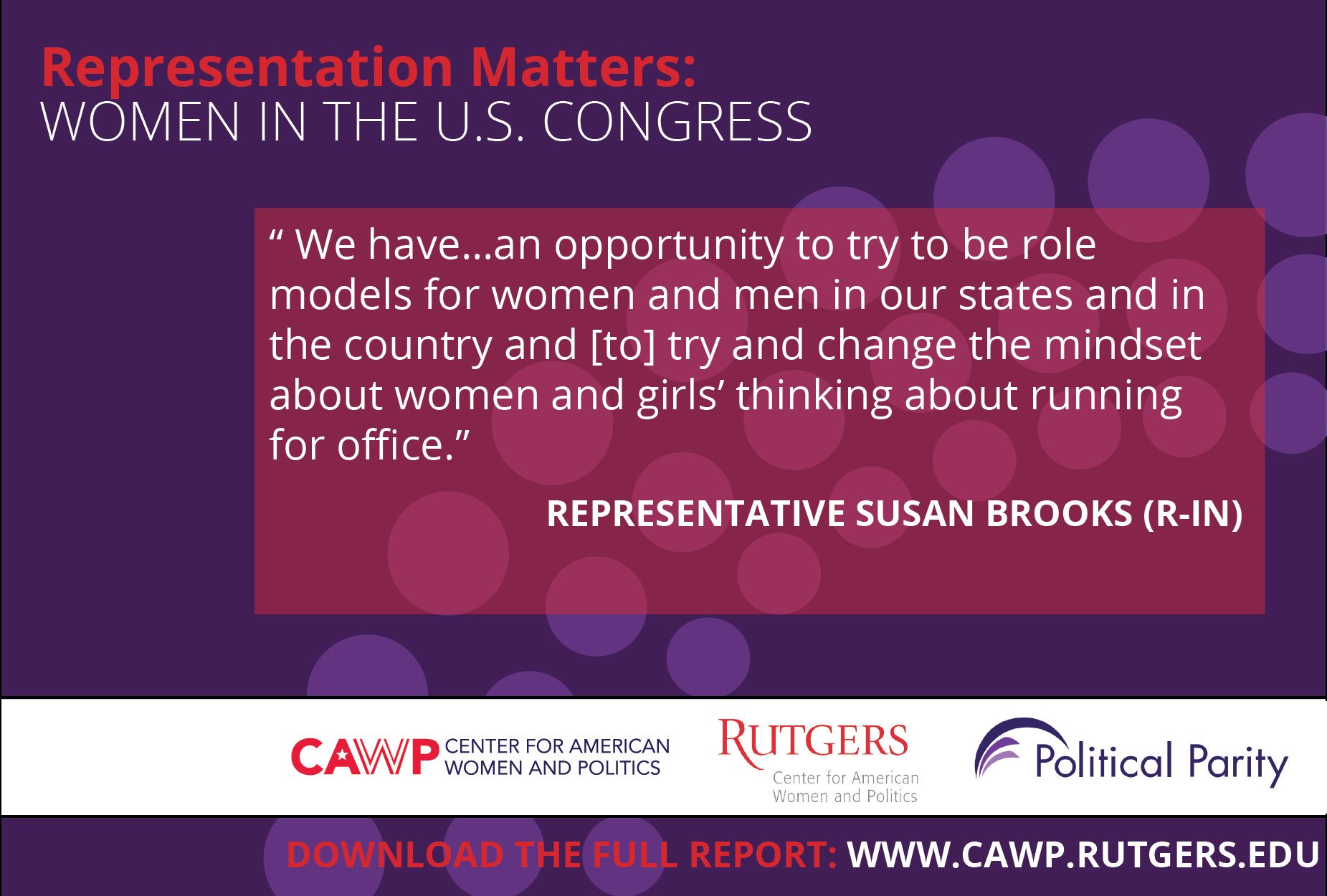
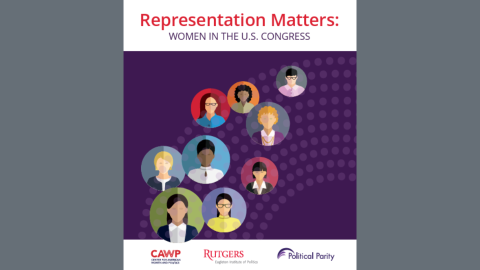
Representation Matters: Women in the U.S. Congress

This CAWP report takes stock of the experiences, perspectives, approaches, and influence of women in the U.S. Congress. Drawing upon the CAWP Study of Women in the 114th Congress, entailing original interviews with 83 of the 108 women who served as senators, representatives, and delegates in the 114th Congress (2015-2016), it shows that women members on both sides of the aisle very much believe that their presence and their voices matter. The interviews provide considerable evidence of women's achievements despite the overall environment of gridlock and party polarization in which the women in Congress operate.

Report
Analysis
Officeholders
U.S. Congress

Candidates Matter: Gender Differences in Election 2016

We looked at gender and party differences in candidate numbers and success in election 2016 to better understand why women made so little progress in representation. Our data demonstrates, consistent with research to date, that there appears to be no consistent gender disparity in candidate win rates; the real gender disparities exist in the proportions of women and men running at each phase of the electoral process. These conclusions are consistent across party, though the dearth of women candidates is particularly acute in the Republican party. 

Report
Analysis
A Closer Look
Candidates
State Legislature
Statewide Executive
U.S. Congress

Women in the 115th Congress

In 2017, 104 (78D, 26R) women hold seats in the U.S. Congress, comprising 19.4% of the 535 members; 21 (16D, 5R) women (21%) serve in the U.S. Senate and 83 (62D, 21R) women (19.1%) serve in the U.S. House of Representatives. 

Report
Analysis
A Closer Look
Officeholders
U.S. Congress
Subscribe to U.S. Congress