Publications

CAWP research and research by CAWP scholars that addresses emerging questions about American women's political participation. 

Reset Filters
  • Book Chapter
    December 26, 2005

    State Elections: Where Do Women Run? Where Do Women Win?
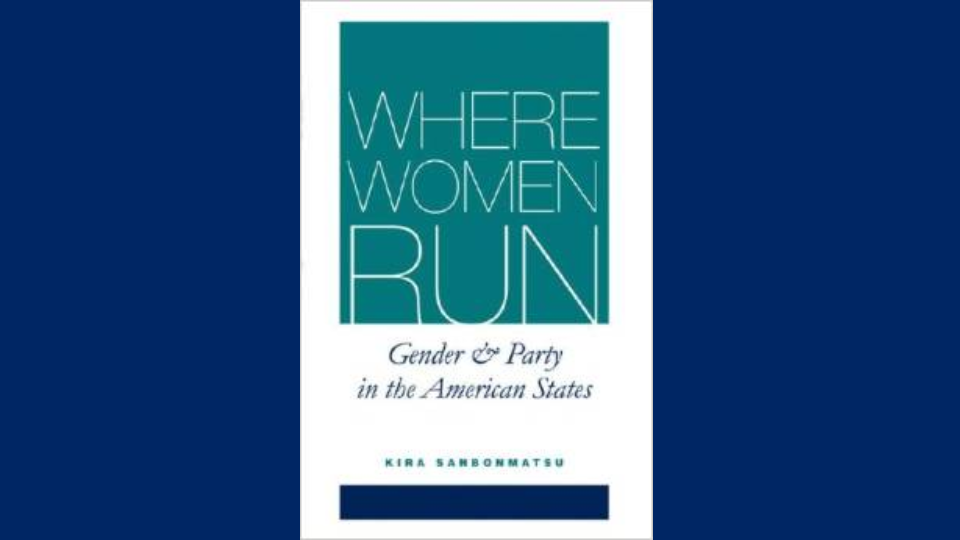
    This chapter reviews and analyzes women's candidacies and officeholding across the 50 states, with particular attention to women's in state elections in 2004. Sanbonmatsu asserts that the pattern of women's representation in the states is a map to the future of women's opportunities for the highest echelons of American politics, noting that some states provide more favorable environments for women candidates than others. 

  • Article
    November 18, 2005

    ‘She Brought Only a Skirt:’ Gender Bias in Newspaper Coverage of Elizabeth Dole’s Campaign for the Republican Nomination
    This article examines differences in print media coverage of Elizabeth Dole and five other Republican contenders for the presidential nomination in 1999. Findings indicate that Dole received a differential amount and type of print media coverage that was decidedly gendered and may have hindered her candidacy. Journalists also repeatedly framed Dole as the “first woman” to be a serious presidential candidate and focused on her gender more than any other aspect of her candidacy, suggesting implicitly, if not explicitly, that she was a novelty in the race rather than a strong contender with a good chance of winning.

  • Article
    August 30, 2005

    Increasing Diversity or More of the Same? Term Limits and the Representation of Women, Minorities, and Minority Women in State Legislatures
    This paper examines the question of whether term limits lead to greater diversity among legislators in terms of their gender, race, and ethnicity. Their findings from an analysis of electoral outcomes in states where term limits were in effect in 1998 and 2000 suggest that the answer to the question of whether term limits lead to more diverse legislatures is not straightforward.

  • Report
    June 1, 2005

    Gender and Civic Engagement: Secondary Analysis of Survey Data

    This CAWP-funded study explores whether gender is salient in civic engagement. For the most part, author Jenkins determines that “[y]oung women and men appear to be receiving the same cues about politics, elected officials, and the political process.” While young men and women appear to behave in a similar fashion, “young women are distinguishing themselves from young men on some key precursors to engagement, particularly attentiveness and knowledge." 

  • Article
    January 15, 2005

    2004 Elections and Women: An Analysis of Statewide and State Legislative Election Results

    An analysis of the 2004 elections and disappointing outcomes for women. Findings suggest that the future for women in state government will depend, at least in part, upon the strength of efforts to actively recruit women for both elected and appointed positions. Legislative leaders, political parties, and advocacy organizations can help by renewing their commitment and augmenting their efforts to identify and offer support to potential women candidates, especially in winnable races with open seats or vulnerable incumbents. 

  • Article
    December 1, 2004

    Women in State Government: Historical Overview and Current Trends

    Women have significantly increased their numbers among state government officials over the past several decades. However, despite a recent increase in the number of women governors, women’s progress, especially at the statewide elective and state legislative levels, has slowed. The future for women in state government would seem to depend, at least in part, upon the strength of efforts to actively recruit women for elective and appointive positions.

  • Book
    January 1, 2004

    Democrats, Republicans, and the Politics of Women’s Place

    This comprehensive study of gender equality debates in the party system from 1968 to 2000 reveals the impact that these changes have had on the political parties. It brings new theory, data, and analyses to bear on the questions of party politics, electoral realignment, and the women's movement.  

  • Article
    December 1, 2003

    Gender-Related Political Knowledge and the Descriptive Representation of Women

    This study finds that political knowledge of one kind--knowledge about the actual level of women's representation--is related to support for having more women in office. Individuals who underestimate the percentage of women in office are more likely than individuals who know the correct percentage to support increasing women's representation. Meanwhile, individuals who overestimate the percentage of women in office are less likely to support increasing women's representation. Ironically, women are more likely than men to overestimate the presence of women in office. 

  • Article
    November 1, 2003

    Political Knowledge and Gender Stereotypes

    This study uses original data to investigate the individual-level determinants of voters’ political gender stereotypes. The author finds that beliefs about men’s emotional suitability for politics predict voter stereotypes about the ability of politicians to handle issues, whereas political knowledge predicts voter stereotypes about politicians’ issue positions. Therefore, whereas some political gender stereotypes can primarily be explained by beliefs about the traits of men and women in general, other stereotypes are more related to knowledge about politics. This study suggests that whereas some political gender stereotypes may change if differences in the behavior of men and women

  • Report
    September 1, 2003

    Candidate Recruitment and Women's Election to the State Legislatures

    This report points out that where women run is a critical but overlooked question in studies on women’s successes in running for office. The report finds that candidate emergence and recruitment differs across states. To varying degrees, party recruitment, beliefs about women’s electability, interest groups, and the presence of women legislators, women leaders, and women’s organizations in a state all play a role in the likelihood of a woman running for the legislature.

Showing 101 to 110 of 163 resources